KEMERTON CONSERVATION TRUST
|
'Conserving wildlife and ancient landscape' |
Registered Charity Number: 702488 |
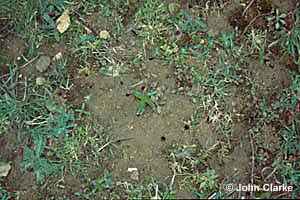
In 1997, as part of the final landscaping of Kemerton Lake Nature Reserve, a screen bank was built adjacent to the footpath and hedge marking the north west boundary of the site. The bank was built from subsoil removed during gravel extraction. In April 2000, while the bank was being checked for colonising vegetation, a large number of Mining Bees were seen. Their nest holes were mainly on the more-sparsely vegetated south east facing slopes with smaller numbers on the top. Two different specimens were collected – the first identified by John Meiklejohn as Andrena dorsata, the other by Geoff Trevis as Andrena flavipes . On the 19th April 2001, despite the bank becoming increasingly vegetated there were large numbers of Mining Bees present. Several specimens were taken and passed to JM. On 26th April the colony was even busier and more specimens were collected for JM. He identified Nomada rufipes and N. fabriciana – two klepto-parasites of Mining Bees – and GT confirmed Andrena flavipes. As this would be the first known site in Worcestershire for A. flavipes GT sent the specimen on to Mike Archer who agreed the identification. The extent of the colony along the slope of the bank was measured and five random 1m square quadrats were thrown, within which a total of 560 nest holes were counted. This produced an average number of 112 holes per square metre. The total area covered by the colony was 120m x 2m, giving an estimated 26,880 holes. The Mining Bees were observed feeding at a variety of plants in the vicinity – including Veronica persica, Myosotis arvensis, Glechoma hederacea, Prunus spinosa and Ulex europeus. The bank was checked by JC and JM on 20th June but there was no bee activity. However on 25th July the colony was again active and a samples were taken to JM who did not find any new species. In July several other, smaller colonies were found at the reserve. On 29th March 2002 GT, HG and JC visited the area and GT identified Andrena cineria. Two Little Owl pellets found on the Mining Bee bank were almost entirely composed of bee remains. Bombylius major was seen at a nearby Mining Bee colony and has since been seen at the Kemerton Lake site. On April 18th 2002 Harry Green and JC visited the site and the Mining Bees were very active but a violent hailstorm brought proceedings to an abrupt end. HG collected a grey fly that was visiting the burrows. David Green identified it as Leucophora personata - a parasitic fly. The following day, JC returned and carried out a full survey of the reserve. Mining Bees seemed to occur wherever there was bare ground – even in wheel ruts and Rabbit scrapes. The survey counted only larger colonies – where more than 500 nest holes were visible. Seven larger colonies were identified and despite the destruction of some nest entrances by the previous day’s storm a total of 40,000 holes were counted. It was interesting to note that the number of nest holes in the original bank had fallen to 15,000 from 26,880 in 2001. During this visit it was observed that a Mole had been very active along the bank but not on either side. This led to speculation that the mole was feeding on the contents of Mining Bee nests. GT, JWM, HG and John Partridge visited the site on the 8th May. The colony was still active and GT collected specimens of Halictus tumulorum and Lasioglossum morio. On 16th May JC and HG visited. Activity was dying down and no new species were found. Mining Bees were found feeding at a variety of plants in and around the reserve – bees were found up to 200 metres from the colonies. Food plants included Crataegus monogyna, Ranunculus repens, Taraxacum agg, and Arctium minus. On one of his visits GT also collected a Cuckoo Bee Psithyrus vestalis. He has also identified two specimens sent to him by HG (collected in 2002) as Colletes daviesana and Lasioglossum smeathmanellus . The main colony was reported as very active on the 1st July. More samples were collected on 21st August when the colony showed was still fairly active but no new species were identified. Fergus Henderson – the summer warden at Kemerton Lake collected a specimen on the 5th September which JM identified as Halictus rubicundus. As a small experiment a ‘turf’’ was lifted from the main Mining Bee bank, during the April breeding period. The sample measured 15cm x 15cm by 15cm deep. The turf was carefully broken up by removing 2cm at a time (starting at the top) and searching for signs of bee nests. No nests were found in the top 5cm. In the tunnel ends various stages of breeding were found – some were empty, some with traces of pollen/nectar. Others held a single egg or a larva, together with pollen/nectar. There were clearly different larval species also present. Within the turf 8 Mining Bee larvae were found, measuring up to 1cm long. There was no nest lining or ‘cell’. 3 small unidentified larvae were found in otherwise empty tunnels and were assumed to be klepto-parasite spp. The sample is too small to use for definitive counts but shows that the larvae can occur at a density of 355 per square metre (when JC was studying Mining Bee colonies in Scotland he found densities of Colletes succinctus of over 900 per square metre). Geoff Trevis et al feel that the Kemerton Lake Mining Bee colonies may be of national importance and that there may well be several rare species of Hymenoptera present. As the site is being rapidly colonised by vegetation a pilot management has been undertaken by Kemerton Conservation Trust. The trial includes chemical control of the vegetation – particularly on the main bank, but also in a second area. On November 18th an area 100m x 4m on the bank and an area 20m x 3m along the bank of the lake was sprayed. This will be repeated as required to prevent plant roots from destroying the nest tunnels and to allow clear access for the bees in April 2003. Much of the bare ground will be protected from Rabbits by pegging down wire netting. It is proposed that more visits will be made during the spring and summer to collect specimens. After that a discussions should be held on the future of the colony. It is worth noting that during the Scottish study JC found that for no obvious reasons colonies of Mining Bee were sometimes apparently completely abandoned – there are a number of theories about this phenomenon. |

|
'Conserving wildlife and ancient landscape' Registered Charity Number: 702488 |